

The 2025 UK Court of Appeal found a lookalike brand infringed Thatchers’ registered trade mark under Section 10(3). While there was no consumer confusion, the court ruled the supermarket took unfair advantage of Thatchers’ reputation, which lead to high initial sales for the supermarket brand.
Lookalike Brands, Whole Label Trade Marks, UK & EU Infringement, UK Court of Appeal Decision (2025) EWCA Civ5; Case # CA-2024-000463
In 2025, there was a notable Court of Appeal case which confirmed the boundaries on how close lookalike brands can get to established market leading brands without infringing their UK registered trade marks. This is best explained by example of the trade mark involved in the actual Court of Appeal decision.
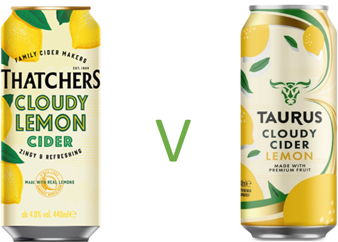
Registered Trade Mark Lookalike Supermarket Own Brand
The Infringement Test – UK Registered Trade Marks
The test for registered trade mark infringement in the UK and EU includes the following:
• Section 10(1): Use of an identical trade mark for identical goods or services;
• Section 10(2): Use of an identical or similar trade mark for identical or similar goods or services, where there exists a likelihood of confusion, including a likelihood of association; and
• Section 10(3): Use of an identical or similar mark where the mark has a reputation in the UK, and the use of a sign, being without due cause, takes unfair advantage of, or is detrimental to, the distinctive character or repute of the trade mark.
Application of Infringement Tests
In this specific case, the analysis was as follows:
• Section 10(1): The lookalike supermarket product is clearly not identical to the Thatchers registered trade mark. Result: No infringement under Section 10(1).
• Section 10(2): The Supermarket product is similar to the Thatchers trade mark, and the goods are identical. However, because of the clear TAURUS branding, there is no likelihood of confusion. The evidence filed at the court demonstrated that consumers were well aware that the Supermarket lookalike brand is not a Thatchers product. Result: No infringement under Section 10(2).
• Section 10(3): To succeed under this section, Thatchers had to show that all the following conditions were met:
1. The Supermarket branding was identical or similar to the registered trade mark; and
2. The Thatchers registered trade mark had a reputation in the UK; and
3. The use of the Supermarket TAURUS label without due cause took unfair advantage of Thatchers’ registered trade mark; or
4. The use of the Supermarket TAURUS label was detrimental to the distinctive character, or the repute of the Thatchers registered trade mark.
The Thatchers mark had been registered since May 2020, and the original court case was brought soon after. The first action was commenced on September 22, 2022, in the UK Intellectual Property Enterprise Court (IPEC), and the decision of first instance by the IPEC was issued on January 24, 2024. The decision of first instance was that the mark did not infringe.
However, unhappy with the result, Thatchers took the case to the Court of Appeal, and the final decision of infringement was given by the Court of Appeal on January 20, 2025. Whilst the Court of Appeal found that there was no infringement on Sections 10(1) or 10(2), the Court of Appeal overturned the original IPEC decision under Section 10(3) and found that there was infringement under Section 10(3).
Infringement under Section 10(3) is not dependent on the goods or services being similar and is not dependent on there being any likelihood of confusion. Instead, it is necessary to establish that the trade mark as registered has a reputation in the United Kingdom, and the use of the sign, being without due cause, takes unfair advantage of, or is detrimental to, the distinctive character or the repute of the trade mark. There have been very few previous decisions where infringement has been found under Section 10(3).
Concerning showing that the Thatchers mark had a reputation, the required level of evidence was significant, but achievable. Thatchers filed sufficient evidence by way of sales receipts, advertising spend and promotion of the trade mark as registered to establish that their mark had acquired a significant reputation in the UK.
Concerning showing detriment to the distinctive character of the Thatcher’s trade mark there were evidential difficulties in establishing this. Detriment is also sometimes called ‘tarnishment’ or degradation of the mark. Detriment is caused when the goods or services for which an identical or similar sign is used by the third party may be perceived by the public in such a way that the trade mark’s power of attraction is reduced. The likelihood of such detriment may arise in particular from the fact that the goods or services offered by the third party possess a characteristic or a quality which is liable to have a negative impact on the image of the registered mark. In this case, the Thatcher’s product included real lemon juice from concentrate and used dessert apples which were more expensive than cider apples. The Supermarket product contained e number flavourings and no real fruit juice and was made from cheaper cider apples.
Consumers have different expectations between the market leader product and an own brand product which are at different price points. Without any confusion between the products, it was difficult to show tarnishment of the Thatcher’s brand. There was no detriment to the Thatchers registered trade mark.
Concerning showing unfair advantage, Thatchers filed evidence that showed a slow build-up of sales for their product, whereas the Supermarket’s evidence of their lookalike showed a high level of sales from the outset. There was presented the concept of a springboard effect or riding on the coat tails of the brand leader which gave the Supermarket an immediate strong sales figure. The Supermarket downplayed this effect by submitting that their other own label brands also showed strong sales from the outset, and so there was no springboard effect from the Thatchers label, but ironically the evidence they supplied to support their position was from their other lookalike brand
of the Strongbow product - which also could be expected to have benefitted from the spring board effect of that market leader.
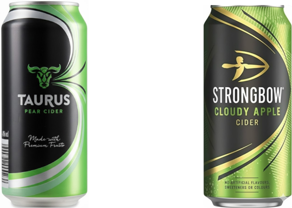
Taurus Pear Cider Strongbow Cloudy Apple Cider

Taurus Rosé Cider Strongbow Rosé Cider
The supermarket had also made TAURUS pear and rosé cider lookalike products based on the Strongbow get-up and a lemon cider lookalike based on the Thatchers get up. Strongbow did not sue, likely because the Supermarket was also selling the Strongbow product alongside the own brand look alike product, and there are no ongoing repeat business prizes for a manufacturer suing their own customer. Thatchers however did not sell to the Supermarket and so felt no reason not to enforce their trade mark rights.
The Court of Appeal found that that the own brand supermarket lemon cider product achieved significant sales in a short period of time without any promotion.
Thatchers had previously pleaded that the unfair advantage was due to transferring an image of their trade mark to the Supermarket packaging: “The Defendant’s use of [the graphics on the (Supermarket) Product] … will cause a transfer of image from the Thatchers Product and the Trade Mark to the (Supermarket) Product and its appearance in the mind of consumers.”
It was found that the Supermarket own brand took unfair advantage of the Thatchers trade mark.
The Supermarket was found to have infringed the Thatchers registered trade mark and withdrew the product, as well as being liable for the usual payment for damages and a contribution towards legal costs.
Copyright protection vs Section 10(3)
Copyright is an unregistered right independent of and distinct from registered trade mark protection and arises automatically whenever an original literary or artistic work is created.
Copying of the image of lemons on a white background was not enough to fall foul of the separate and distinct rights under copyright protection. The idea of showing lemons on a white background is not protected by copyright, as copyright protects an expression of an idea rather than the idea itself. But under Section 10(3) test for registered trade mark infringement, there is the separate and unrelated concept of “image transfer” which in this case was found to have occurred.
Whereas copyright protects all original images, and is generally an unregistered right, Section 10(3) protects only trade marks which have been registered.
Commentary
Section 10(3) was introduced into the 1994 UK Trade Marks Act resulting from an EU directive. The test for infringement under Section 10(3) includes taking “unfair advantage”. In the United Kingdom, there is no such thing as a law of unfair competition per se, although continental European countries do have local unfair competition laws. Hence, Section 10(3) represents a part of EU law which has been imported into UK law.
In the present Thatchers Court of Appeal case, there was the opportunity for the UK Court of Appeal to produce a decision which diverged from EU law now that the UK has left the European Union, but rather instead the Court of Appeal chose not to diverge from EU law.
There is much to be said for registering the whole label of the product, as well as the main brand word mark. Look alike traders generally apply careful benchmarking and take legal advice on how close they can get to copying a market leader before creating their own look alike brand. The incentive to create a lookalike brand is to obtain a sales boost from the reputation of the market leader without incurring the marketing cost investment needed to establish a brand, but without infringing any registered or unregistered rights. That exercise gets a lot harder when the incumbent product is protected to the maximum extent by registration of trade marks for the whole label as well as the core word brand and any distinctive logos of the brand.
Article by Robert Franks, December 15, 2025
Section 10 of the UK Trade Marks Act in Full
S10 Infringement of registered trade mark.
(1) A person infringes a registered trade mark if he uses in the course of trade a sign which is identical with the trade mark in relation to goods or services which are identical with those for which it is registered.
(2) A person infringes a registered trade mark if he uses in the course of trade a sign where because -
(a) the sign is identical with the trade mark and is used in relation to goods or services similar to those for which the trade mark is registered, or
(b) the sign is similar to the trade mark and is used in relation to goods or services identical with or similar to those for which the trade mark is registered,
there exists a likelihood of confusion on the part of the public, which includes the likelihood of association with the trade mark.
(3) A person infringes a registered trade mark if he uses in the course of trade, in relation to goods or services, a sign which;
(a) is identical with or similar to the trade mark,
(b) where the trade mark has a reputation in the United Kingdom and the use of the sign, being without due cause, takes unfair advantage of, or is detrimental to, the distinctive character or the repute of the trade mark.
(3A) Subsection (3) applies irrespective of whether the goods and services in relation to which the sign is used are identical with, similar to or not similar to those for which the trade mark is registered.
(3B) Where the risk exists that the packaging, labels, tags, security or authenticity features or devices, or any other means to which the trade mark is affixed could be used in relation to goods or services and that use would constitute an infringement of the rights of the proprietor of the trade mark, a person infringes a registered trade mark if the person carries out in the course of trade any of the following acts—
(a) affixing a sign identical with, or similar to, the trade mark on packaging, labels, tags, security or authenticity features or devices, or any other means to which the mark may be affixed; or
(b) offering or placing on the market, or stocking for those purposes, or importing or exporting, packaging, labels, tags, security or authenticity features or devices, or any other means to which the mark is affixed.
(4) For the purposes of this section a person uses a sign if, in particular, he -
(a) affixes it to goods or the packaging thereof;
(b) offers or exposes goods for sale, puts them on the market or stocks them for those purposes under the sign, or offers or supplies services under the sign;
(c) imports or exports goods under the sign;
(ca) uses the sign as a trade or company name or part of a trade or company name;
(d) uses the sign on business papers and in advertising; or
(e) uses the sign in comparative advertising in a manner that is contrary to the Business Protection from Misleading Marketing Regulations 2008.
This article is available as a download (see below). If you believe your trade mark is being infringed, or you are unsure whether your trade mark will infringe another, contact one of our expert attorneys for advice.
Our Attorneys
Abdulmalik Lawal Abdulmalik.Lawal@franksco.com
Abigail Welford Abigail.Welford@franksco.com
Haroon Kahn Haroon.Kahn@franksco.com
Iryna Vasyliv Iryna.Vasyliv@franksco.com
Jon Banford Jon.Banford@franksco.com
Luke Franks Luke.Franks@franksco.com
Robert Franks Robert.Franks@franksco.com